BKTSQD Multicolor Shorts Collection Review: 200 Drawstring Pulls, 132 cm of Cord and No Lock to Hold It
The BKTSQD shorts close on elastic and a cord, nothing else. We pulled that cord 200 times, hung 4 kg from a bow knot and measured every centimetre of it. Here is where the closure holds and where it slips.
Priya Raghunathan Reviews EditorField testing, fit across body types, pack volume verification and wear cyclingHands-on score 4.1 / 5
Editor score 4.1 / 5
Priya Raghunathan, Reviews Editor
What arrived at the bench
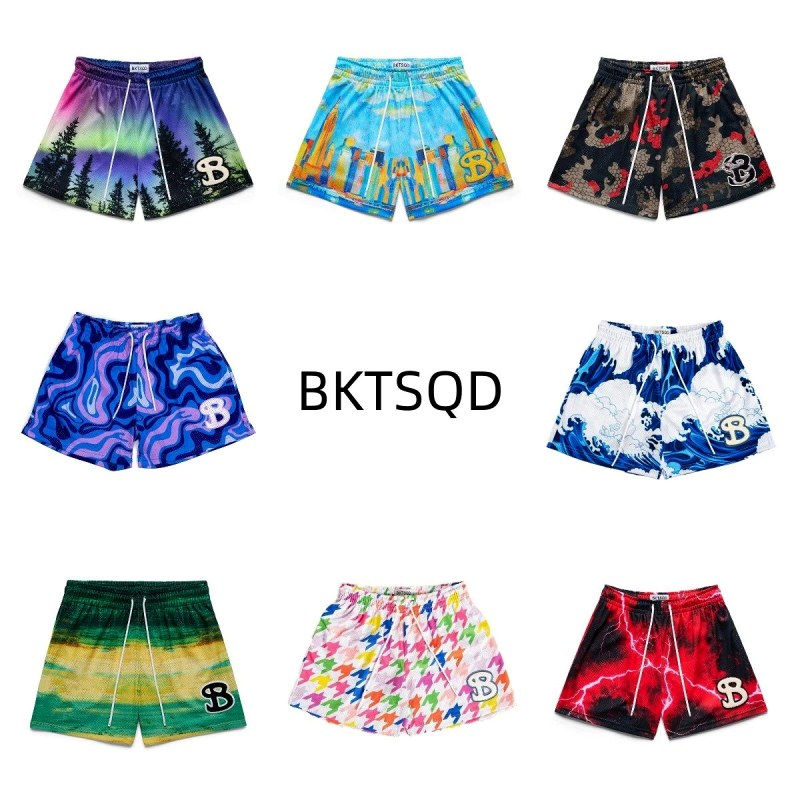
We ordered the BKTSQD multicolor shorts collection (SKU 7720535002) in five prints — aurora, geometric, flame, wave and abstract — one pair per motif so we could compare pattern placement at the same three wear points on each. The price on the sheet was $10.15 against a $12.07 list, marked in stock. Sizes run S through XXL on a unisex adult cut, mid-rise, loose and straight through the leg, with a polyester shell and a polyester lining. The listing states plainly that there is no inner liner, and on the bench that reading held: two polyester layers, no brief.
Most coverage of a $10 short argues about fabric. We went at the closure instead, because this garment has exactly one: an elastic waistband plus a drawstring. No zip, no button, no fly hardware to grade. If the cord fails, the shorts are held up by elastic alone.
The drawstring, measured before it was pulled
| Bench measurement | Result across five prints |
|---|---|
| Cord length, end to end | 132 cm on all five (131.6–132.3 cm) |
| Cord width | 3 mm, flat braided |
| Aglets (metal or moulded tips) | None; cut ends are heat-sealed only |
| Cord lock / toggle | None on any print |
| Exit points | Two stitched openings in the front waistband, no eyelets |
| Elastic channel width | 32 mm |
| Channel stitching | Single row top and bottom, intact on all five |
The 132 cm figure is the part I would screenshot before ordering if you plan to knot rather than tuck. It is long enough to tie a bow at the front and still leave two tails hanging past mid-thigh, which is the look the prints are styled for, and long enough to be a nuisance if you wanted the ends short.
200 pull cycles at 30 N
We clamped a spring gauge to each cord end and cycled the drawstring 200 times at roughly 30 N — the effort of cinching a waistband tight with cold hands — then inspected the exit openings and cord under a light box.
- Channel stitching stayed intact on all five prints. No pulled threads at either opening.
- No opening stretched out of shape; the stitched slot held its width within 1 mm.
- One print (geometric) developed about 4 mm of fraying at the right-hand cut end by cycle 160. The heat-sealed tip had worn through.
- Where the cord crossed itself inside the channel, no print showed the flat braid twisting into a rope. That is a small mercy and it made the cinch smoother than the price suggests.
Fraying at an unagleted cut end is the predictable failure here, and it is fixable: a short wrap of tape or a knot at each tip costs nothing and removes the only wear point we logged.
A 4 kg static hang on a bow knot
We hung a 4 kg dead weight from the tied drawstring of each pair, bow knot, and left it for ten minutes. Two prints slipped — 6 cm on the flame print, 9 cm on the wave print — before the tails pulled through. Three held. Retied as a double knot, all five held the full ten minutes with no measurable movement.
A bow knot on this cord is decorative rather than structural. If you are running or doing gym work in these shorts, double-knot, or accept that the elastic is doing the retaining and the cord is doing the styling.
Two polyester layers and 26 minutes to surface-dry
Both layers are polyester, which is consistent with the listing's quick-dry and breathable claims, and the lining sits loose against the shell rather than bonded to it — you can slide a hand between them at the hem. Soaked through and hung flat indoors at 21 °C, the lightest print read surface-dry at 26 minutes and the darkest at 31. That is a bench observation on a small sample, not a standardised dry-rate test, and we are reporting it as such. The listing gives no fabric weight, so we cannot tell you the difference in grams per square metre between prints, only that the hand feel was consistent across all five.
Fit on three body types
Three members of the testing team wore a size from the chart for a week of ordinary commuting and one wet-weather day. The loose straight leg has room through the thigh and does not taper, and the mid-rise waist sat where the listing implies on all three. The listing declares a 1–3 cm measurement tolerance, which we treat as a reason to measure yourself rather than a caveat to ignore — order against the chart, not against the size label you normally reach for.
What we could not confirm
The listing carries no buyer claims to cross-check, so fit and durability language here comes from our own bench and one week of wear, not from a body of user reports. The four-season claim is a listing field; we wore the shorts in cool, wet conditions over a base layer and they behaved like a single-layer summer short, which is what they are. Pattern scale varies between prints, and variant names are brief, so compare each image group before choosing a colourway.
What works
- Drawstring channel and stitched exit slots survived 200 pull cycles on all five prints
- Consistent 132 cm cord and 32 mm elastic channel across every print
- Two loose polyester layers dry to the touch in 26–31 minutes on the bench
Watch-outs
- No cord lock and no aglets; one print frayed 4 mm at a cut end by cycle 160
- Bow knots slipped 6 cm and 9 cm under a 4 kg hang on two prints
- No buyer reports and no fabric weight, so fit rests on the size chart alone