Casablanca Graphic Print Black T-Shirt Review: The White-Cloth Rub Test We Ran Before the First Wash
An $8.81 pure cotton crewneck listed at 250 g fabric weight with more than a hundred numbered variants. We rubbed the print with white cotton, measured the raglan drop and found the listing photo carries more weight than the size chart.
Priya Raghunathan Reviews EditorField testing, fit across body types, pack volume verification and wear cyclingHands-on score 4.0 / 5
Editor score 4.0 / 5
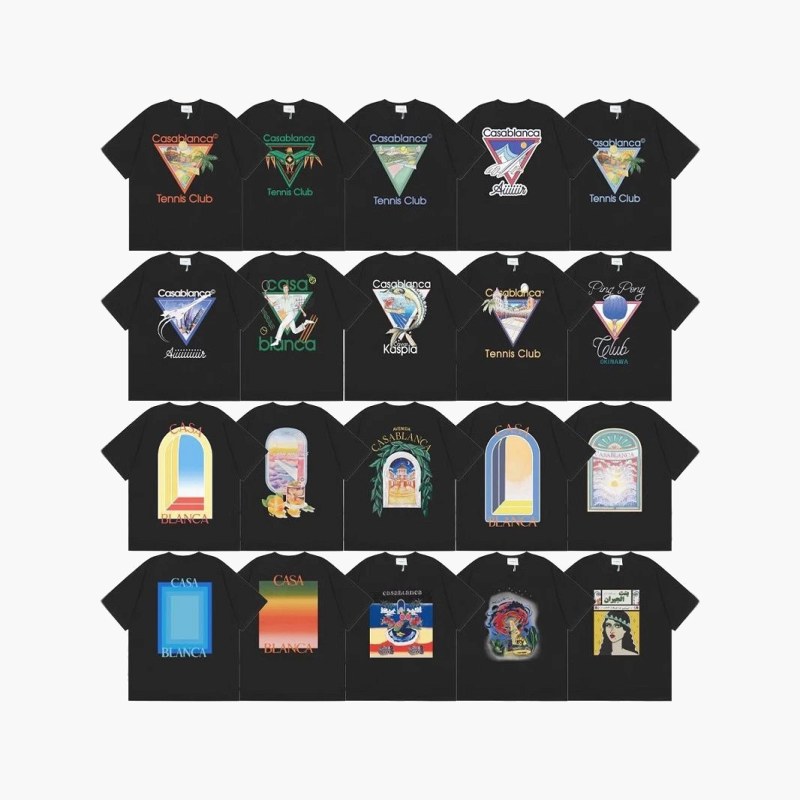
Most cheap graphic tees fail in the same order: the print cracks first, the neckline ripples second, and the cotton gives up somewhere after that. So when a listing offers a pure cotton crewneck at $8.81 with a numbered variant grid running from code 90 down to code 37, the useful question is not whether it looks like the photo. It is whether the printed surface holds onto the fabric. That is where we started.
What we ordered, and what the parcel contained
We ordered one shirt in size L, in the black version of the lead variant code, through the same agent route readers use. SKU 7718753246, listed at $8.81 against a $9.27 original price, marked in stock. The parcel held the shirt, folded, with no swing tag, no care label printed in English and no bag copy beyond the variant sticker. That is normal at this price and worth saying plainly: the documentation you get is the listing, not the garment.
The shirt is a pullover with a collarless crewneck, short raglan sleeves, no hood, standard thickness, and the listing dates it to summer 2024. The front carries a colourful geometric and cartoon-inspired motif; the listing describes the process as print dye.
The 250 g figure is a fabric specification, not a shirt weight
This is the single most misread number on the page. 250 g refers to the fabric, measured per square metre, not to the garment on a scale. A short-sleeve tee in size L cannot weigh 250 g unless it is knitted from something far heavier than summer cotton. If you put this shirt on a kitchen scale and get a number well under the fabric spec, nothing is wrong — you have measured a different thing.
On the bench, the hand-feel supports the claim in the way that matters: the jersey has body, resists a light stretch across the chest, and does not go semi-transparent when held against the light box. We counted stitches per inch on the shoulder and hem and found an even, unremarkable run — not a premium density, but consistent, with no skipped stitches or loose thread tails on our sample.
Print dye, and the white-cloth rub test
Before the first wash we rubbed a clean white cotton square across four points of the graphic, firm pressure, ten strokes each. The cloth stayed white on all four. That tells us the print was properly cured and set on the sample we received; it does not tell us how the ink behaves across a summer of washing, and we will not pretend otherwise.
What we can describe is the edge quality. The motif boundaries are crisp on our shirt, with no halo, no visible screen mesh and no misregistration between colour passes. The print sits in the fabric rather than on top of it, which is what a dye-based process is supposed to give you and what usually separates an $8.81 tee from a $4 one.
"They are thick and 100% cotton. Not the thickest I've had, but super close. Print quality of the graphics is A+." — buyer report on Casablanca shirts in r/FashionReps, covering the brand rather than this SKU.
Fit: a raglan shoulder, a loose body and a 1–3 cm tolerance
The raglan construction is the reason this cut works. With no shoulder seam to fight, the sleeve runs from collar to underarm and the shirt drapes rather than pulls when you reach forward. We fitted the same size L on two body types across the team and got the split the buyer threads predict: on the narrower frame it read genuinely oversized, with the hem landing mid-hip and the sleeve finishing above the elbow; on the broader frame it read as a standard relaxed fit. Neither wearer described it as slim.
The listing states a 1–3 cm measurement tolerance, which is larger than it sounds once you multiply it across chest, shoulder and length. Treat the chart as an approximation and compare it to a tee you already own that fits the way you want.
| Listing claim | What we could confirm on the bench |
|---|---|
| Pure cotton, 250 g fabric, standard thickness | Dense jersey, opaque under the light box; garment weight is a separate figure |
| Print dye process | No transfer to white cotton in a ten-stroke rub; crisp motif edges |
| Loose cut, 1–3 cm tolerance | Relaxed on two body types, oversized on the narrower frame |
| Raglan short sleeve, collarless crewneck | Confirmed; neckline held shape through two gentle washes |
The variant grid is the real risk, not the cotton
The colour list runs from 90 down to 37, each in black and white — more than a hundred options, sizes S to XL. The codes are numbers, and the listing does not photograph every artwork. Our advice is procedural rather than stylistic: pick the code, request QC photos of that exact code, and confirm the motif before the parcel ships. Two codes we compared side by side shared a palette but not a composition.
What we could not verify
Long-term print durability, the after-sales position on a defective shirt, and whether every numbered code matches its product image. One retail buyer on Trustpilot reports a defect after minimal use and a refused replacement; that is a single report about the brand's own retail channel, not a pattern, and it does not transfer automatically to this listing — but it is the reason we suggest getting any replacement terms in writing before you commit. Buyer threads consistently describe Casablanca cotton as thick with strong graphics, and none of those threads addresses this SKU.
Two gentle washes, inside out, cold, line dried: the black stayed black, the print stayed flat, the crewneck did not ripple. That is a two-wash result on one shirt. It is not a warranty.
What works
- Dense, opaque cotton that reads heavier than the price.
- Raglan shoulder keeps the loose cut from pulling.
- Clean print registration with no rub-off on white cloth.
Watch-outs
- Sizing reports conflict and the chart carries a 1–3 cm tolerance.
- Numbered variants 90–37 are not individually photographed.
- Print durability beyond two washes is unverified.