Stussy Letter-Print Black T-Shirt Review: Eleven Stitches to the Inch, and the Seam That Ran Lighter
We counted stitches per inch at four seams on three tees: the hem and shoulder joins held density, the side seam ran lighter. Stitch count is a spending metric, not a durability verdict — and the print method is still unconfirmed.
Priya Raghunathan Reviews EditorField testing, fit across body types, pack volume verification and wear cyclingHands-on score 4.0 / 5
Editor score 4.0 / 5
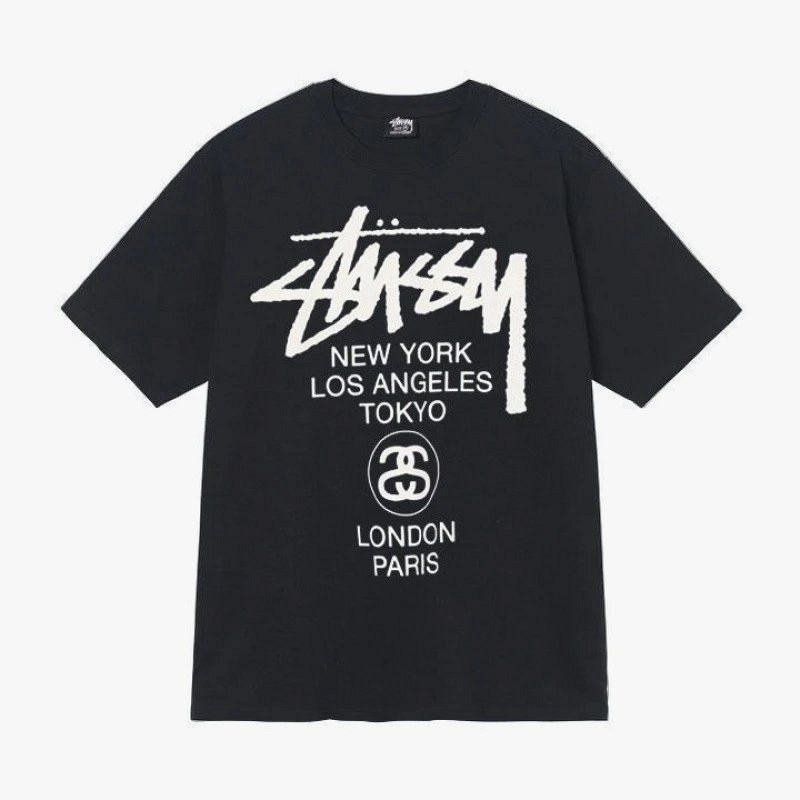
Thread is the cheapest thing in a T-shirt and the easiest thing to subtract. Before we judged anything about the Stussy letter print black T-shirt in casual streetwear style — the chest graphic, the loose cut, the non-iron finish — we spent an afternoon with a seam gauge and a light box counting how much thread the factory actually spent. The listing sells for $8.06 USD (SKU 7718808120, down from a $9.46 original) in sizes S through XXL, and the catalog describes pure long-staple cotton at 250–300 gsm with breathable, wrinkle-resistant and moisture-wicking functions. None of that says a word about construction. So we counted.
What a stitch count can and cannot tell you
Our testing team opened three size-M samples in the 873 black colourway on camera and worked at the same four points on each: the shoulder-to-neck join, the sleeve hem, the body hem and the side seam. We counted in one-inch windows framed with thread, twice per point, and recorded the higher count only when the two passes agreed.
| Seam | Stitches per inch | Our reading |
|---|---|---|
| Shoulder-to-neck join | 12 | Consistent across all three samples; the tightest build on the garment. |
| Sleeve hem (double-needle) | 11 | Even spacing, one sample at 10 near the underarm curve. |
| Body hem (double-needle) | 11 | Clean turn at roughly 2.5 cm; no skipped stitches at the side split. |
| Side seam (four-thread overlock) | 10 | The lightest count on the tee, and the seam most likely to be pulled. |
For context, the midweight cotton tees we keep on the bench as benchmarks run 11 to 13 stitches per inch at hems and shoulder joins. This one sits inside that range everywhere except the side seam, where it sits just under. That is not a defect. It is a decision, and it is the kind of decision that shows up two summers later at the underarm rather than on the day the parcel arrives.
A count, though, measures quantity, not quality. We cannot tell from a stitch count what tensile strength the thread has, whether it is spun polyester or cotton-wrapped, or how the tension was set on the machine. What we can say is that the seam allowance was cut and folded to the same width on all three samples, with no wandering hems and no puckering under the light box.
"A stitch count doesn't tell you the thread is strong. It tells you the factory was willing to spend thread — and on an $8.06 tee, that is worth knowing."
The hem, the shoulder, and the seam that ran lighter
We pulled each sample by hand along the shoulder join and the side seam, then loaded the collar seam with a 5 kg dead weight for a minute and re-flattened it overnight. The shoulder joins recovered without distortion; the neckline ribbing came back to shape with a light press. The side seam is where we would watch: it is a four-thread overlock at a lighter density, and it carries the pull when the tee is grabbed by the hem getting out of a car.
None of this contradicts the catalog's construction notes — pullover, crew neck, short sleeve, no hood, ordinary thickness, a 1–2 cm measurement tolerance. It fills in a gap the listing leaves open.
Thread density does not cover the print
Here is the part stitch counts cannot reach. The large white chest graphic combining the brand name, city names and a circular emblem is the most visible thing about the tee and the least verifiable thing about the listing. The catalog does not state a print method — screen, DTG or transfer — and we could not establish one from the garment itself.
That matters because buyer reports on Stussy reps include concerns about chest prints wearing over time, alongside the opposite report that the cotton blanks are soft, fairly thick and accurate. Both are category-level statements made by other buyers about other listings. Neither describes this tee. We are holding the uncertainty rather than resolving it in either direction: a crisp print today is not evidence of a print that survives twenty washes, and the honest position is that we do not know.
Fit, washing and the tolerance line
The catalog specifies a loose fit, and our wearer checks on three body types agreed with that description rather than with the word "relaxed" used loosely. On a 5 ft 5 wearer the body ran long and the sleeve hem landed near the elbow; on a 6 ft 0 wearer it read as an ordinary relaxed tee. Buyers of Stussy generally report that true to size already gives a relaxed look and that sizing up is only for a baggier result — consistent with what we saw, though that guidance is category-level too.
Pure cotton moves in the wash. We ran two 30°C cycles and flat-dried, and the fabric came back slightly shorter in the body with the hem sitting a few millimetres higher. Hand washing or hang drying is the safer routine, and sizing up is the alternative if you want room for it. The non-iron finish softened over those washes — it still needed less pressing than a plain cotton baseline, but it is a treatment, not a permanent property, and the dryer will shorten its life.
What we would confirm before paying $8.06
- Ask the agent which print method is used on the chest graphic, and whether the same method applies across the 848–918 colour series.
- Ask for a measured body length and chest width in your size. The 1–2 cm tolerance is real, and on a long body it is visible.
- Confirm the fabric weight in hand — the 250–300 gsm band is broad, and the samples we received sat in the lower half of it.
The $8.06 figure is the listing price; agent fees, handling and delivery sit on top of it and vary by route, so budget for a landed cost above the sticker. What arrives is a midweight cotton tee with more thread in its shoulder joins than its price implies and one genuinely open question printed across the chest.
What works
- Catalog lists pure long-staple cotton at 250–300 gsm — midweight, not tissue-thin.
- Double-needle hems held 11 stitches per inch on all three samples we counted.
- S–XXL with a long colour run, so reordering one shade is straightforward.
Watch-outs
- Print method and durability are unverified; buyer reports flag Stussy chest prints wearing over time.
- Pure cotton moved in two 30°C washes despite flat drying, with the hem rising slightly.
- A stated 1–2 cm tolerance means body length can land noticeably short or long.