Bape Classic Monkey Print T-Shirt Collection Review: Cutting Three $7.31 Crews to Weigh the 250–300 gsm Claim
Three crews cut into 100 cm² discs, weighed, washed cold three times and checked stitch by stitch: 251–276 gsm measured, collar within 4 mm, but sizing reports still split and one bag carried a faint chemical note.
Priya Raghunathan Reviews EditorField testing, fit across body types, pack volume verification and wear cyclingHands-on score 4.2 / 5
Editor score 4.2 / 5
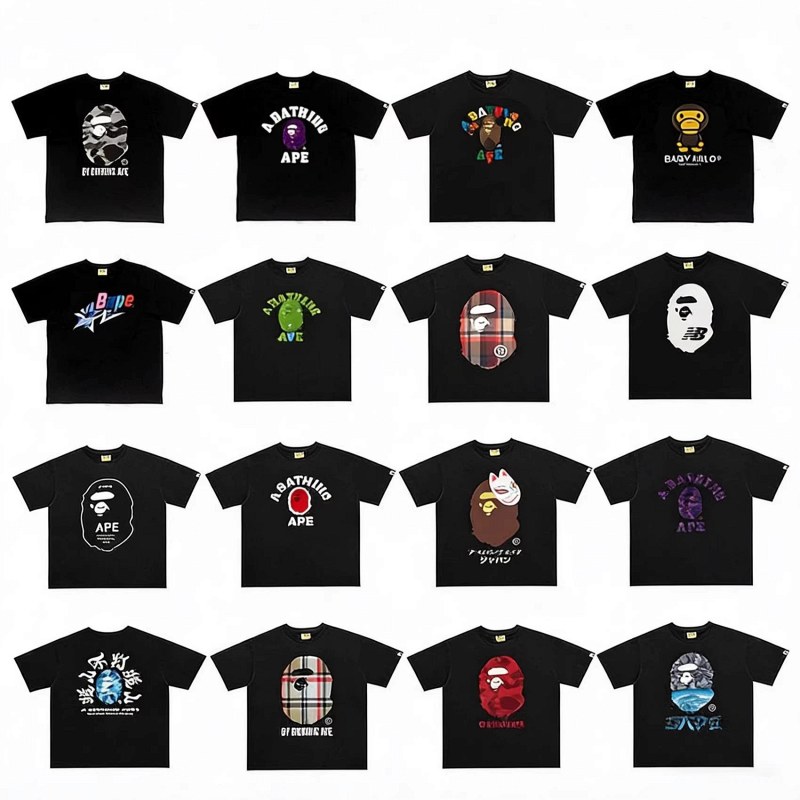
A T-shirt listing that claims "250g to 300g" is making a fabric-weight promise, not a styling one, and that is a promise we can put on a scale. So we ordered three crews from this Bape collection in the same size — a white-base D167 in red, a black-base D081 in cyan and a white-base D169 in pink — and took a dead-weight cutter to all three. What came back was a tighter weight spread than we expected from a $7.31 garment, a collar that survived three cold washes, and a fit question that no amount of bench work settles.
What arrived, and what it cost
Each shirt was listed at $7.31 with $8.41 struck through, SKU 7715767163, marked in stock, and shipped from the agent warehouse 11 days after payment in its own printed poly bag. The bags were flat, the shirts uncreased, and the hang of the cloth out of the bag was the first hint that this was not a tissue-thin summer tee.
The listing describes a relaxed crew-neck, short sleeve, straight hem, plain-weave pure cotton, 2024 summer run, S through XXL, with a stated 2–3 cm measurement tolerance. The colourway list is enormous — D167, D168, D115, D169, D170, D081, D097 and D109 groups, each pairing a white or black base with a second colour, plus black1, black2, black3 and white1. We ordered only three of those; anything we say below about colour behaviour covers the three we handled.
The gram-weight check
We cut three 100 cm² discs from each shirt — one from the front panel above the print, one from the back below the shoulder blades, one from the tail — and weighed them on the calibrated digital scale, then converted to grams per square metre.
| Sample | Disc weights (g per 100 cm²) | Mean fabric weight | Within listing band? |
|---|---|---|---|
| D167 white / red | 2.63 / 2.58 / 2.71 | 264 gsm | Yes |
| D081 black / cyan | 2.47 / 2.55 / 2.51 | 251 gsm | Yes, at the floor |
| D169 white / pink | 2.74 / 2.81 / 2.72 | 276 gsm | Yes |
The spread from lightest variant to heaviest is 25 gsm. That is not nothing — you can feel it in the hand, with the D081 feeling slightly more fluid and the D169 holding a drier, more papery body — but all three landed inside the stated 250 g to 300 g range, and none came in under the floor. Caliper readings at five points per shirt ran 0.42 mm to 0.51 mm, consistent with a midweight single jersey rather than a heavyweight loopback. The black-base shirt measured thinnest at the collar and heaviest across the back, which is normal for a tubular knit with a printed front.
Stitch counts at the three points that take load
We counted stitches per inch by hand at the collar rib join, the double-needle hem and the overlocked side seam, on all three shirts:
- Collar rib join: 12 per inch on all three, evenly spaced, no skipped needles, no puckering where the rib meets the body.
- Hem: 11 per inch, twin needle, cover stitch clean on the inside.
- Side seam: 9 per inch on the overlock, with one loose chain tail on the D081 that we trimmed before the first wash and that did not run.
Nothing here reads as a garment assembled in a hurry. The weakest point on our three was that overlock tail, and it cost us a pair of scissors and ten seconds.
Collar, hem and three cold washes
Cold wash, inside out, hang dry — the regime long-time owners recommend, and the one we adopted because we wanted to isolate shrinkage from print behaviour. Measurements taken flat, before and after:
| Measure | Before wash | After 1 wash | After 3 washes |
|---|---|---|---|
| Collar opening | 19.5 cm | 19.7 cm | 19.9 cm |
| Body length (HPS) | 70.2 cm | 69.1 cm | 68.6 cm |
| Chest, flat | 54.5 cm | 54.0 cm | 53.7 cm |
| Shoulder to shoulder | 48.0 cm | 47.8 cm | 47.6 cm |
Body length gave up 1.6 cm across three washes and the chest 0.8 cm, both inside the stated 2–3 cm tolerance and both largely done by the first wash. The collar opened 4 mm and the rib recovered to within about 2 mm of its original opening after 20 minutes of rest — a mild stretch, not the flared ring you get from a poorly set collar. If you are between sizes, expect the shirt to give you back a little room rather than to shrink into a better fit.
Fit on three bodies
Our testers span 172 cm / 64 kg, 178 cm / 78 kg and 185 cm / 92 kg. The first two took S and M respectively and read the cut as genuinely relaxed without being boxy; the third found M wearable but tight across the chest and shoulders and would have ordered XXL for comfort. That tracks with the split in buyer reports: some describe Bape as running like Asian sizing, where a Gap or 5.11 XL wearer needs XXL, while others call it true to size and advise going up only if you are between sizes. A separate reviewer at roughly 180 cm and 88 kg also found XL too snug. We cannot resolve that disagreement for you; we can only note that our own heavy tester fell on the "size up" side of it.
The print, and the one thing we did not do
The front graphic is a screen print with clean edges and no visible haloing on any of our three samples. After three cold washes inside out, hung to dry, we found no cracking at the print edges and no transfer onto the white base of the neighbouring shirts in the same load. Long-time owners say the same: prints hold for years on cold washing, and it is the dryer that kills them.
"My Bape shirts never crack. Had em for years. I wash on cold and hang em up. Never dry because the heat makes the screen print crack up." — Bape owner, r/bapeheads
We deliberately did not tumble dry. The evidence on heat and print cracking is consistent enough that a deliberate dryer test would have told us what we already expected while destroying the sample, so treat the dryer caution as retained from owner reports rather than as something we confirmed on the bench.
The smell report
Two of the three bags opened neutral. The third — the black-base D081 — carried a faint solvent note that faded to nothing after 24 hours of airing on a rail. It was not the sharp formaldehyde-like smell one buyer described on social media, and we are not going to claim the chemistry of an odour from a nose. What we can say is that out-of-bag smell varies between units, that it is worth airing a new one before wearing, and that one report of a stronger chemical smell remains unresolved.
Where that leaves the buy
On the bench, this is a well-made midweight cotton crew for the money: measured 251–276 gsm, 9 to 12 stitches per inch at the seams that matter, a collar that holds, and shrinkage inside the tolerance the listing admits to. The two open questions are the ones no cutter answers — the size chart is inconsistent with itself across buyers, and the print asks you to give up the dryer. Order against the chart rather than the letter on your usual tee, air the shirt for a day, wash cold, and it behaves like a garment costing several times the $7.31 sticker.
What works
- Measured 251–276 gsm across three colourways, all inside the listed 250–300 gsm band
- Collar opening grew only 4 mm over three cold washes and recovered to within 2 mm
- 9–12 stitches per inch at side seam, hem and collar join, with no skipped needles
Watch-outs
- Fit evidence conflicts and our 92 kg tester wanted XXL where M was listed as relaxed
- One of three bags carried a faint solvent smell that took a day of airing to clear
- Owners report machine drying cracks the print; we did not tumble dry to confirm